
YG3 vs Framer for SEO: marketing sites vs service-business schema
Framer is fast for marketing sites and startups. For default service-business SEO it scored 64; YG3 scored 100.
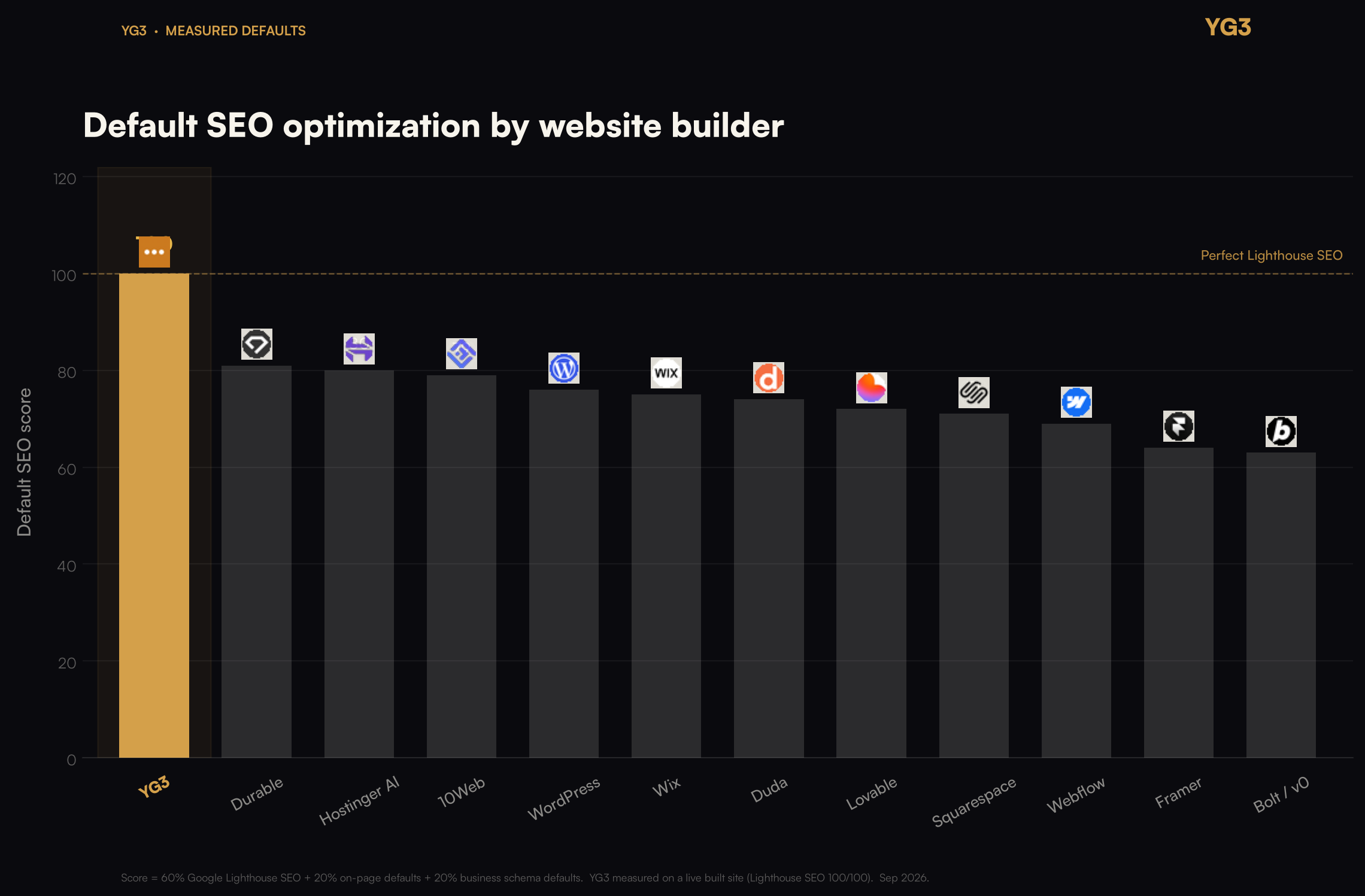
Direct answer: For default service-business SEO, YG3 (100) beats Framer (64). Framer is built for fast, design-forward marketing pages — a different job than shipping a LocalBusiness-ready site for a trade or professional practice.
Part of the September 2026 default SEO website builder benchmark. Also compare: Wix · Squarespace · WordPress · Webflow · Framer · AI builders.

Key takeaways
- YG3 scored 100; Framer scored 64.
- Framer shines for motion, polish, and startup / product marketing pages.
- Entity depth for local services is not the product priority.
- Choose Framer for campaign and product launches; choose YG3 for Main Street findability.
How this score was measured
All scores in this series use the same September 2026 default-SEO test. We graded what ships when you publish without an SEO specialist or a plugin suite — not a fully optimized agency build.
- 60% Google Lighthouse SEO (mobile, headless Chrome)
- 20% on-page defaults (title, meta description, canonical, Open Graph,
lang, single H1) - 20% business schema defaults (JSON-LD depth for a local / service business: LocalBusiness, address, phone, hours, services where applicable)
Full scoreboard and caveats: Best SEO website builder benchmark.
The scores
| Builder | Default SEO score (Sep 2026) |
|---|---|
| YG3 | 100 |
| Framer | 64 |
Where Framer is strong
Motion, visual polish, and iteration speed for modern marketing pages. Startup landing pages and campaign microsites are a natural fit.
Framer also attracts designers who want production-quality interaction without a full engineering sprint — valuable when the site’s job is conversion storytelling, not local entity clarity.
Where Framer falls behind by default
- Entity depth. Service-area businesses need address, phone, hours, and clear entity markup. Framer defaults do not prioritize that.
- On-page hygiene varies. Canonicals, H1 discipline, and meta completeness depend on the template and author.
- Wrong tool for Main Street. If the customer is a local operator, Framer’s strengths are mostly orthogonal to ranking needs.
- AI citation weakness. Assistants summarizing “who is this business?” need structured facts, not only a beautiful hero.
Side-by-side criteria
| Criterion | YG3 | Framer |
|---|---|---|
| Marketing-page speed | Strong | Excellent |
| Default LocalBusiness schema | Yes | Not the default priority |
| Local / service findability | Primary job | Secondary |
| Best for | Operators who must be found | Product / campaign launches |
When to choose which
Choose Framer for product marketing and design-forward launches. Choose YG3 for local and service businesses that must be cited and found.
FAQ
Is Framer good for local SEO?
Not by default in our test. Framer scored 64 on the composite; YG3 scored 100. Framer can host content, but LocalBusiness depth is not the product focus.
Should a SaaS startup use Framer or YG3?
Often Framer (or similar) for the marketing site. YG3 is aimed at operators and agencies shipping findable service businesses, not only product launches.
Can Framer add schema?
You can add custom code. The benchmark grades what ships without that specialist step.
Read the full scoreboard on the benchmark hub. See the product on the YG3 website builder page, or start free.


