
YG3 vs Webflow for SEO: designer control vs LocalBusiness automation
Webflow gives designers precise control. Default SEO for a service business still scored 69 vs YG3’s 100 in our benchmark.
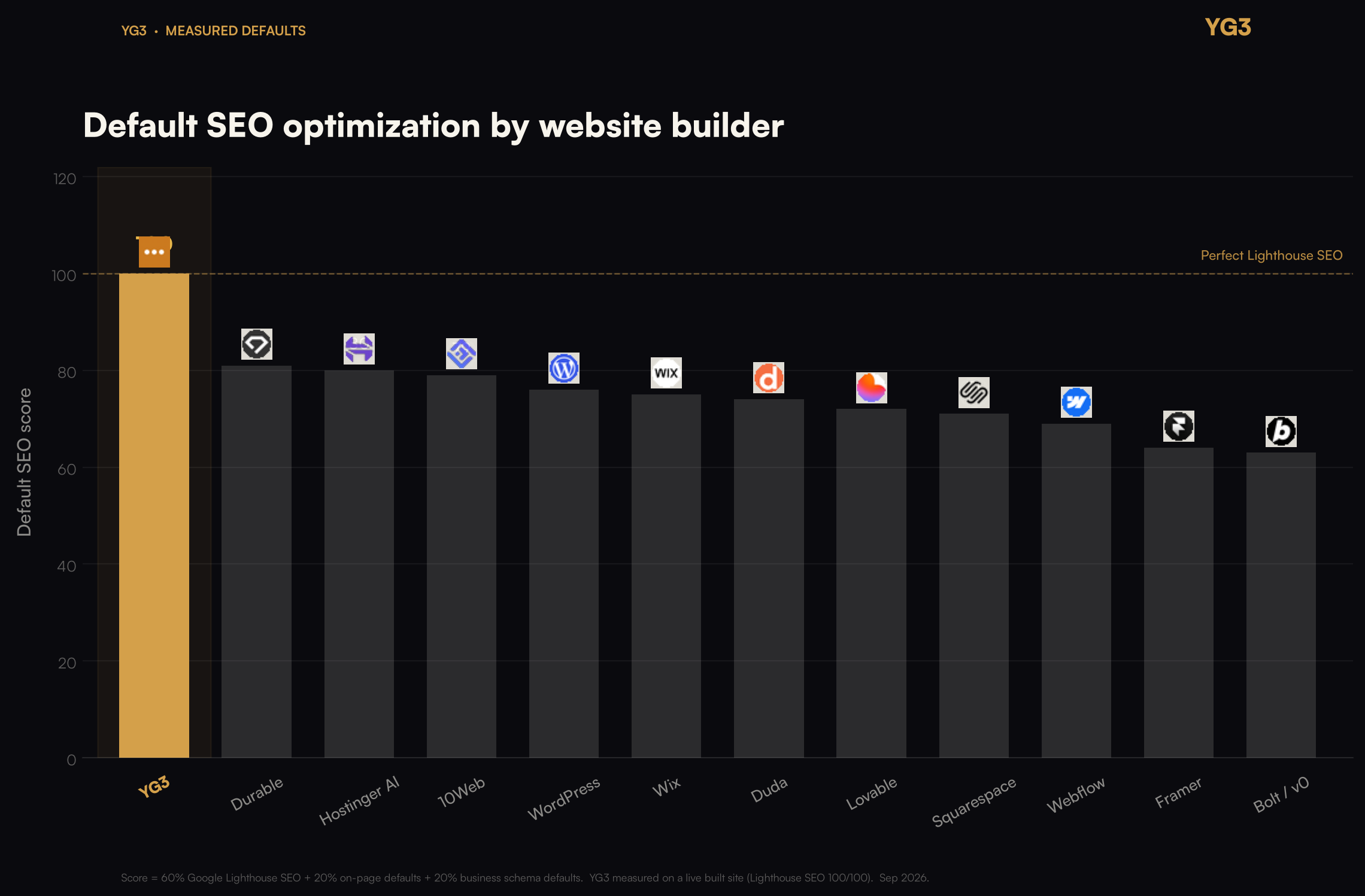
Direct answer: For default service-business SEO, YG3 (100) beats Webflow (69). Webflow is an excellent design canvas; LocalBusiness structure is something you build into the project, not something the platform invents from a business profile.
Part of the September 2026 default SEO website builder benchmark. Also compare: Wix · Squarespace · WordPress · Webflow · Framer · AI builders.

Key takeaways
- YG3 scored 100; Webflow scored 69.
- Webflow wins on layout control, CMS collections, and interaction design.
- Schema and meta discipline depend on the implementer.
- Choose Webflow for custom design systems; choose YG3 for findable service sites without a build team.
How this score was measured
All scores in this series use the same September 2026 default-SEO test. We graded what ships when you publish without an SEO specialist or a plugin suite — not a fully optimized agency build.
- 60% Google Lighthouse SEO (mobile, headless Chrome)
- 20% on-page defaults (title, meta description, canonical, Open Graph,
lang, single H1) - 20% business schema defaults (JSON-LD depth for a local / service business: LocalBusiness, address, phone, hours, services where applicable)
Full scoreboard and caveats: Best SEO website builder benchmark.
The scores
| Builder | Default SEO score (Sep 2026) |
|---|---|
| YG3 | 100 |
| Webflow | 69 |
Where Webflow is strong
Layout control, CMS collections, and interaction design are first-class. Marketing sites that need bespoke art direction often belong here — if someone owns the SEO implementation.
Webflow is also strong when the site is really a design system: components, shared styles, and marketing pages that change weekly under a designer’s hand.
Where Webflow falls behind by default
- Schema is hand-built. LocalBusiness JSON-LD is not generated from a profile the way YG3 does it.
- Blank canvas risk. Freedom means missing canonicals, weak heading order, or incomplete meta unless the build is disciplined.
- Time-to-rank-ready. A Webflow site can become excellent; it is rarely excellent on SEO the afternoon a non-technical owner publishes.
- Agency dependency. The best Webflow SEO outcomes usually imply a technical partner — which is fine, and not “default.”
Side-by-side criteria
| Criterion | YG3 | Webflow |
|---|---|---|
| Design precision | Product templates + generation | Pixel-level control |
| Default LocalBusiness schema | Automatic from profile | Hand-implemented |
| Owner can publish alone | Yes | Often needs a builder |
| Best for | Service findability | Custom marketing systems |
When to choose which
Choose Webflow for custom design systems with a technical implementer. Choose YG3 when the brief is “get this service business online and findable,” not “invent a new layout language.”
FAQ
Is Webflow bad for SEO?
No. Webflow can be strong when SEO is implemented carefully. Our score measures defaults for a service business, where Webflow landed at 69 vs YG3 at 100.
Can I add LocalBusiness schema in Webflow?
Yes, via custom code or embeds. YG3 generates it from the business profile so owners do not have to.
Who should pick Webflow over YG3?
Teams whose primary constraint is custom design and who already staff implementation — not owner-operators optimizing for day-one findability.
Read the full scoreboard on the benchmark hub. See the product on the YG3 website builder page, or start free.


